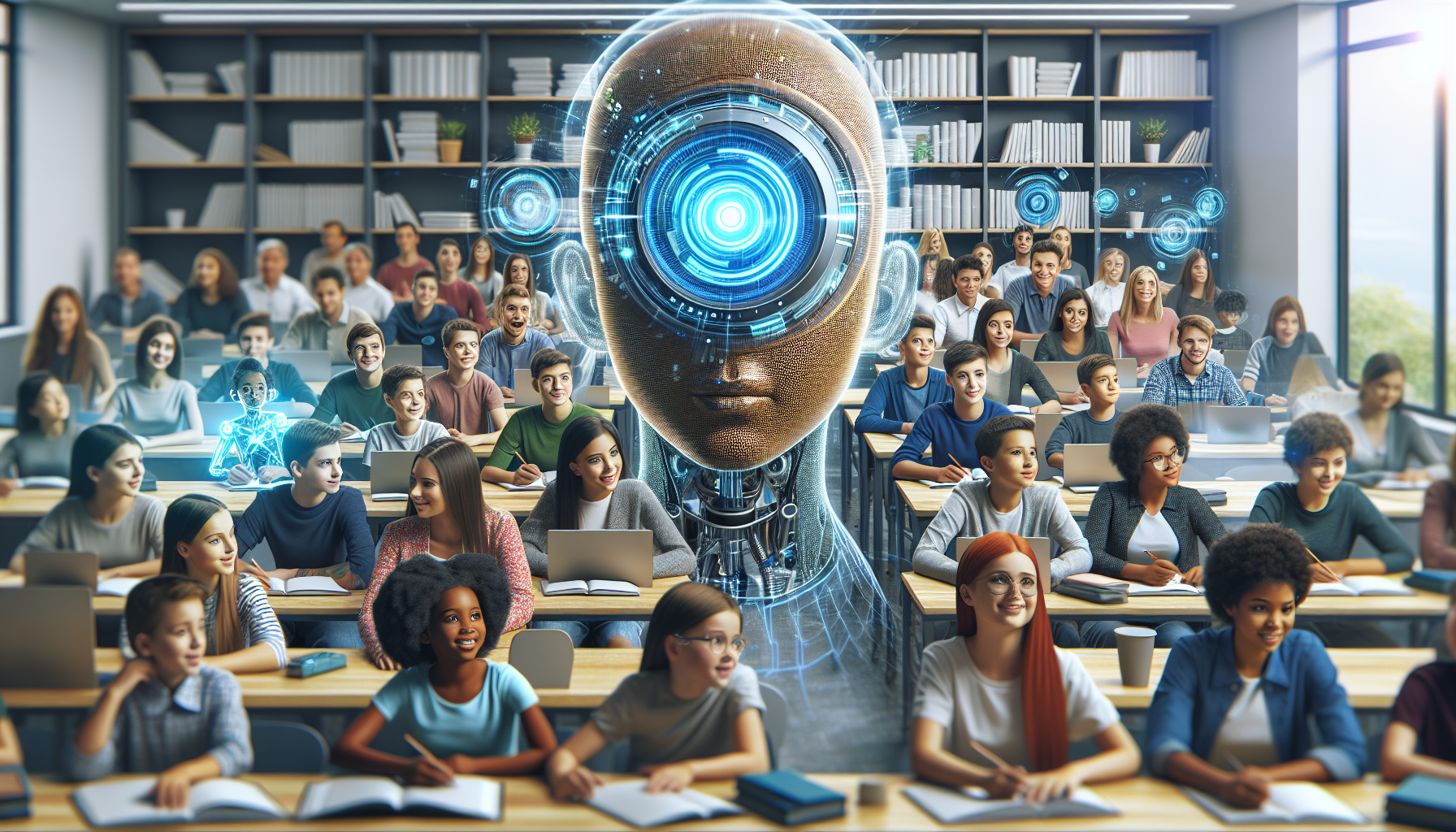
As the world of education undergoes a seismic shift towards digitization, students from Global Management Institute (GMI) are at the forefront of adopting artificial intelligence (AI) into their learning journey. This article delves into how AI is reshaping educational paradigms and equipping young minds to navigate a globalized academic landscape.
The Emergence of AI in Education
Emerging from the narrative that framed AI’s inception and proliferation in education, GMI students are uniquely engaging with AI, not just as passive recipients of knowledge but as active architects of their educational journeys. The integration of AI into their learning processes has fundamentally altered the landscape of tertiary education, enabling personalized learning paths that cater to individual strengths, weaknesses, and learning speeds. This bespoke educational approach has been instrumental in preparing students for a dynamic, technology-infused global market.
The role of AI in education for GMI students extends beyond personalized learning. It encompasses the development of critical skills necessary in navigating digital landscapes and complex global markets. AI literacy, once considered supplementary, has now become fundamental, positioned alongside traditional academic disciplines. Students are not only learning about AI in a theoretical sense but are also applying these technologies in practical, real-world scenarios. This practical application fosters a deep, intuitive understanding of AI’s capabilities and limitations, bridging theoretical knowledge with hands-on experience.
Moreover, GMI’s curriculum is structured to encourage a forward-thinking approach to globalization, inclusivity, and cross-cultural understanding. AI acts as a catalyst for this, breaking down geographical and linguistic barriers through technologies like real-time translation and global collaboration platforms. This inclusivity extends to fostering an environment where students from diverse backgrounds can leverage AI to contribute unique perspectives, promoting a rich, multicultural exchange of ideas.
Lastly, the emphasis on AI in education at GMI is directly aligned with the evolving demands of the job market. With AI becoming increasingly pervasive across industries, GMI students are uniquely positioned to enter the workforce not just as employees who can utilize AI tools, but as innovators who can drive the future development of AI technologies. This alignment ensures that GMI students are not just prepared for the jobs of today but are also capable of shaping the careers of tomorrow.
In transitioning to the next chapter, it becomes evident that GMI’s strategic integration of AI in education is not just about keeping pace with technological advancements. It is about redefining the educational landscape to cultivate a new generation of learners, thinkers, and leaders who can thrive in an interconnected, AI-driven world.
Global Management Institute Students and the AI Revolution
Building upon the foundational understanding of AI’s emergence in education, Global Management Institute (GMI) students are embarking on a unique AI-driven academic journey. They are not mere spectators to the AI revolution but active participants, leveraging artificial intelligence to elevate their learning experiences. This hands-on engagement with AI tools enables them to tailor their educational pathways, catering to personal needs and career aspirations. GMI’s curriculum is pioneering in integrating AI to simulate real-world business environments, thereby preparing students for the complexities of global markets and digital landscapes. The role of AI in reshaping educational content and methodologies is pivotal, as it steers learners towards acquiring a new set of skills, paramount for navigating future job markets.
Moreover, AI literacy is becoming an indispensable component of their academic and professional toolkit. GMI students are learning to harness the power of AI for data-driven decision-making, predictive analysis, and strategic planning, skills that are highly prized in today’s technology-driven marketplace. The institute is at the forefront of creating a learning ecosystem where AI acts as both a bridge and a catalyst for cross-cultural and multidisciplinary collaborations, fostering a global mindset among its students.
This transformation led by GMI is pivotal in democratizing education, making advanced AI tools accessible to a diverse student body. This inclusivity not only enhances academic outcomes but also prepares a generation of learners who are adept at leveraging technology to solve complex problems, thereby contributing to global economic and social landscapes. GMI’s commitment to embedding AI into the fabric of its education system is a testament to its forward-thinking approach, vital for preparing students to excel in a rapidly evolving globalized world.
Conclusions
The integration of AI in education offers transformative opportunities for GMI students to embrace a future-centric learning approach. As they venture into this AI-driven academic odyssey, it is imperative to balance technological advancements with ethical integrity and a commitment to equal access to knowledge. The future of education lies in harmonizing AI’s potential with humanity’s timeless pursuit of wisdom.
Leave a Reply